A trip to Egypt, on the Nile
My brother and I arrived in Egypt in December 2023, one week before christmas. We landed in the airport of Louxor after what might have been our worst flight ever.
On this trip, we wanted to try something new: cruising. Why? Mainly because of the beautiful Nile and the promises of landscapes and views like we’ve never experienced in our lives. Secondly because it made our adventure more agreeable, everything was to be prepared and ready. And it was.
Karnak and the actual city of Louxor

Firstly we went to the city of Louxor, on its east river bank, where the people in ancient Egypt used to live, to follow the sun and its awakening. Precisely, we went in the beautiful and well preserved temple of Karnak. 136 giant columns standing there! It was just mesmerising. Some might say that we began with the best of the best, it might be the case.
It’s known for several reasons. But one fact that struck me when I was there, after the good conservation of the site, is the ampleur of the whole thing. It’s like that because different pharaons added their own edifices to the already existent during a period of time estimated as 2000 years.
Navigating towards the south

After the shock we had in the plane of the contrast between the green around the Nile and the desert, we were on the Nile, watching it all from the boat.
One of the first thing we did was to go on the roof. It was already the end of the day, low orange rays of sun. The muezzins and the clamor that accompanied us throughout Luxor, it’s as if voices were rising from the Nile, “it’s terrifying” I thought, but it was charming too.
We were heading to Edfou and Kom Ombo, two preferred locations of the ancient Egyptians times. The first one for its Ptolemaic temple perfectly conserved. The second one is known for its double temple. We saw that one at night. It’s all white, surely because of the lights too. If you want to see the most beautiful drawings in a temple, go there. Mummies of crocodiles too.
What is the Ptolemaic period?
The Ptolemaic period is the time of ancient Egypt when the Greek ruled the country and took Egyptian culture and adopted it, making themselves Pharaons and Gods.
The Philae Temple

The Philae Temple is particular. It’s a temple on a mini island, circled by the Lake Nasser. This artificial lake was stocked with loads of water after the creation of the high dam of Assouan. In fact, the temple was supposed to be underwater by now if a community of countries hadn’t dismantled it from the original island to be reassembled afterwards on the actual island.
The lake nasser almost putted a high number of temples and ancient miracles into oblivion. The lake was made to sustain a bigger part of agriculture in Egypt and to multiply the production of energy. Fortunately countries acted before it was too late for a lot of temples, the Philae one and others, by changing their locations on higher grounds.
A little ballad at Kom Ombo
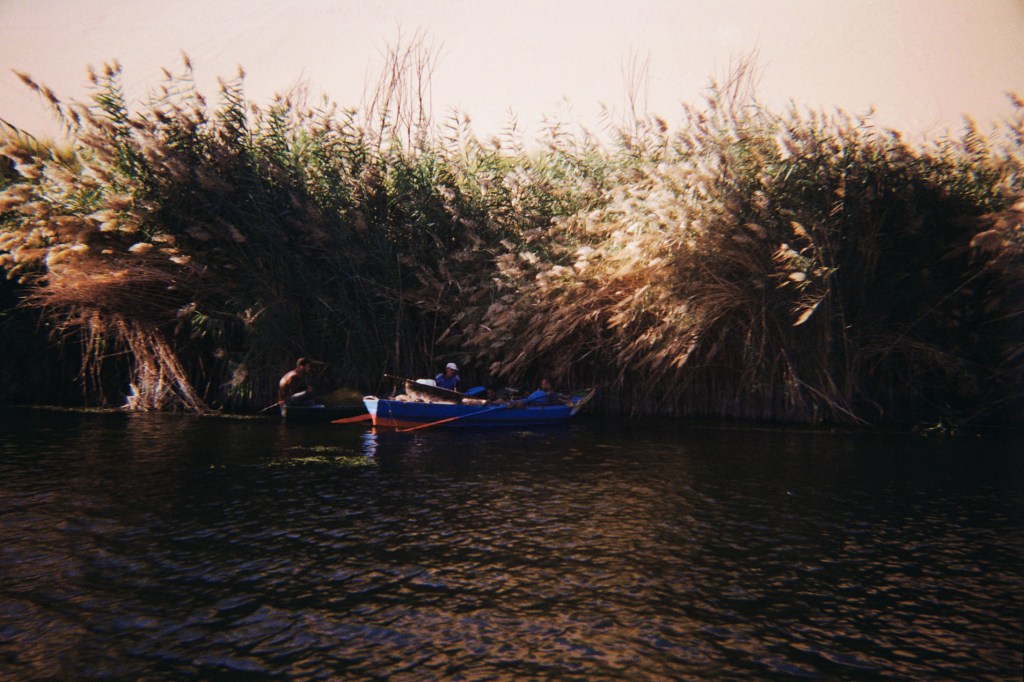
Lacets and mazes of water, between high green herbs, almost accosting into luxurious villas, old prophets on hills, saying hello to fisherman, foot in waters.. apparently no crocodiles here. A sight of other animals though: cats, ducks, herons, water chickens.. a step on shore to go up on a hill, grains as gold as the tresors from Nubia, a sight on the long thin body of water there, touching the eyes and souls with its beauty. Oh it’s trouble to see that and come back home after it.
Up next: crazy temples made in big rocks, Abou Simbel
That day we woke up at 2 o’clock in the morning and took a bus for 5 hours or something with a military convoy in order to see a beautiful site. We arrived with the sun rising, that made everything orange around us. The site is known because of its splendeur of course, but also because it was a spectacular prouesse when it was originally made and when it was moved from one place to another a few years ago (to save it from the lake Nasser).
The two temples were made by Ramses II to worship him and one of his spouses, Nefertari.
Abou Simbel is near the actual Sudan. The two temples are carved into the rock, they’re giant and majestic. They were discovered under piles of sand in the 19th century. After the menacing rise of the lake Nasser, they moved the temples by cutting them out of the rock and placing them back to an artificial mountain way above the ancien site. I can’t imagine how much that cost but the render is awesome.
Who was Ramses II?
He is known as the “builder pharaoh”. He builded temples that worships him everywhere in Ancient Egypt, from the north to the south.
Back to Louxor
After going way south, we got back to our beginning, in Louxor. At this point, we went through a lot of temples of different kind, and even though we were still amazed by them, we surely thought that we had seen it all and that we would not be as shocked as the first temple that we saw. We were wrong because holy molly the valley of the kings and the tombs there were majestic. We only saw three of the 63 tombs: Ramsès IV, Ramsès Ier, Tausert/Setnakht. If you want to see the brightest and craziest colors, you have to go there.
How were Pharaohs buried and worshiped?


First of all, the temple allows the passage of the dead into the beyond, with the deceased continuing to exist through the statue placed in the funerary temple while their body remains in the tomb. Offerings of food were placed in the temple, and rituals were performed. Initially in the Old Kingdom and Middle Kingdom, funerary temples were located in buildings positioned against the eastern face of a pyramid, serving as the tomb (such as near Memphis and the Fayoum, present-day Cairo, former capitals). Later, hypogea were often chosen: tombs carved into the foothills of cliffs (for example, the Valley of the Kings in Thebes, where pharaohs of the New Kingdom are located), distinct from the temple.
They changed the way they buried themselves because of one reason: looters and thiefs. The kings of the New Kingdom wanted to be safe from them because they saw what they did to the pyramids. So they choose a mountain in the west bank of the Nile (where the sun dies) that had and still has the form of a pyramid, going to the sky. But it was a secret place and not much people knew about it so that no problems of looters would happen.
Unfortunately or not, this caused the place to be forgotten until not so long ago. Nevertheless, some people found it and they looted and sold some of the items that they found. But they did not find one place that remained intact: the tomb of Toutankhamon. The young king is known only for the tresors that were found in this tomb. Absolutely staggering and impressive indeed, it is stocked right now in the old museum of Cairo.
Cairo, the last part of our journey

We had to take another plane to go from Louxor and Cairo. This moment haunted us because of our first flight that didn’t go as planned. When we arrived on the tarmac, we were even more terrified: we saw an old plane working with helices. A nightmare. But after all, it was too smooth to be true, no problem no turbulence, great.
And there we were, in Cairo, following our guide to the pyramids of Cheops, Chephren and Mykerinos on the Giza plateau. Outstanding, like nothing we’ve ever seen before.
The pyramids of Giza
The oldest and largest is the pyramid of Cheops, in the northeast. In the center is the one of Chephren. The one belonging to Mykerinos is the furthest southwest and the most modest (62 meters high).
They were constructed in the 3rd millennium BCE.
Cheops is the first wonder of the ancient world. 137 meters high. Originally covered in limestone, which was removed during the Arab period. It’s made of two million three hundred thousand blocks, each one cubic meter in size. Chephren appears to dominate over Cheops, but only because it is built on higher ground. It also retained its limestone casing at its peak. It reaches a height of 136 meters.
And like that, it’s the end
After the visit to the old museum, we went back to the plane and to our boat. What a pleasant journey it was. The history of Egypt is awesome. The Egyptians are too.



 Bergamin Rubens
Leave a comment